Alaska Constellations: A Beginner’s Guide to the Winter Sky

On a clear Alaska winter night, the sky can feel almost as large as the land beneath it. Mountains disappear into darkness, stars sharpen overhead, and patterns hidden by summer light return. You may recognize the Big Dipper immediately—or wonder whether a bright point is Polaris, a planet, or something else.
You do not need a telescope to begin. Alaska’s winter sky rewards simple observation: a warm coat, a dark place, a few minutes for your eyes to adjust, and a willingness to look up. Learning even three or four patterns can turn a beautiful night into a sky you can begin to read.
Why Winter Is Alaska’s Stargazing Season
Stars are present throughout the year, but summer daylight makes most of them impossible to see from Alaska. As autumn deepens and winter approaches, longer nights create more opportunities for stargazing. The National Park Service calls fall, winter, and early spring especially good seasons for viewing stars in Denali, where limited artificial light can reveal the Milky Way and many faint stars hidden near cities.
Clouds, blowing snow, haze, bright moonlight, and outdoor lights all affect what you can see. A clear night away from streetlights usually gives the best view, especially after your eyes have had time to adapt.
Winter also brings a practical advantage: you do not have to wait until the middle of the night. Depending on the date and your location, the sky may be dark enough for stars during the early evening. Our guide to the winter solstice in Alaska explains how dramatically daylight varies across the state.
Start With the Big Dipper
For many Alaskans, the easiest starting point is the Big Dipper. Its seven bright stars form a bowl and curved handle. Technically, the Big Dipper is an asterism—a recognizable star pattern within the larger constellation Ursa Major, the Great Bear.
The Big Dipper is especially meaningful in Alaska because it appears on the state flag. In 1927, the territorial legislature adopted 13-year-old Benny Benson’s winning student design. Its eight gold stars represent the seven stars of the Big Dipper and Polaris. The Dipper symbolizes strength, while the North Star represents Alaska’s northerly position and future.
Once you find the Dipper, look at the two stars forming the outside edge of its bowl—the side farthest from the handle. Imagine a line rising through those two “pointer stars.” Follow that line about five times the distance between them, and it leads toward Polaris.
Polaris: The Star That Helps You Find North
Polaris is not the brightest star in the night sky, despite a common assumption. Its importance comes from its position. It sits very close to the north celestial pole, the point around which the northern sky appears to turn as Earth rotates. While other stars seem to sweep across the sky, Polaris remains in nearly the same place.
Polaris forms the end of the Little Dipper’s handle and belongs to the constellation Ursa Minor, the Little Bear. The rest of the Little Dipper is dimmer than the Big Dipper, so you may locate Polaris before you can trace the entire pattern.
Polaris marks north, but it should not replace a map, compass, GPS, or safe travel plan. Stargazing is a wonderful way to understand direction—not a reason to enter Alaska winter conditions unprepared.
Look for Cassiopeia’s W
On the other side of Polaris from the Big Dipper, look for five bright stars shaped roughly like a W or M. This is Cassiopeia. Its simple shape makes it one of the most recognizable constellations in the northern sky.
Cassiopeia is helpful when the Big Dipper is low or hidden by terrain. The two patterns appear to circle Polaris as the hours pass, making the sky’s apparent rotation easier to notice.
NASA’s Alaska constellation guide identifies Ursa Major, Ursa Minor, and several other northern constellations as circumpolar—visible through the year in the northern sky rather than rising and setting like constellations farther south. Their position still changes through the night and across the seasons, so do not expect the Dipper or Cassiopeia to remain upright.
Orion: The Great Winter Landmark
Turn toward the southern part of the winter sky and look for three bright stars in a short, nearly straight line. They form Orion’s Belt. Four brighter stars around the belt outline the shoulders and legs of Orion, making it one of the easiest large constellations for beginners to recognize.
Orion is a winter favorite in Alaska. Unlike the northern circumpolar patterns, it moves across the southern sky and is seasonal. Its arrival in the evening is one of the quiet signs that winter’s night sky has returned.
Near Orion, you can also look for Taurus and the Pleiades. The Pleiades appear as a small, close group of stars and are often called the Seven Sisters. They are a star cluster—not a constellation by themselves—and dark, clear conditions make the group easier to appreciate.
Stars, Planets, and the Northern Lights
Not every bright point is a star. Planets can resemble unusually bright stars, but they generally twinkle less and shift against the background constellations over time. A current sky chart or reputable app can identify which planets are visible.
The aurora is something different again. The northern lights are produced when charged particles interact with gases in Earth’s upper atmosphere. They may stretch across the same sky as Orion, Cassiopeia, or the Big Dipper, but an aurora is not a constellation and its shape can change from moment to moment.
A bright aurora can overwhelm faint stars. On quieter nights, constellations provide their own steady wonder. The transition from sunset color to darkness—described in our story about alpenglow in Alaska—can make waiting for the first stars part of the experience.
A Simple Alaska Stargazing Plan
Choose an open location away from traffic and strong lights. Check the weather, wind chill, and road conditions. Tell someone where you are going if you travel beyond your neighborhood, and never stop on an unsafe shoulder for a view.
Bring insulated layers and a headlamp with a red-light setting. Dim red light lets you check a chart without losing as much dark adaptation. Binoculars are useful for the Pleiades and Milky Way, but they are optional. Begin with your eyes.
Give yourself 20 to 30 minutes away from bright light. Find the Big Dipper and Polaris, then Cassiopeia, then turn south for Orion. Repeating that sequence on different dates will show how the sky changes.
The Story Behind the Alaskan Constellations Bracelet
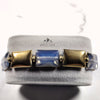
The Alaskan Constellations Bracelet takes its inspiration from the variety and sparkle of Alaska’s night sky. It uses 3mm leather cording in black, brown, or red, paired with differently shaped stainless steel beads that catch light from changing angles.
Rather than mapping one constellation, its metallic shapes recall looking into a dark sky and slowly noticing more points of light. Like learning the stars, the design rewards a second look.
For an Alaskan, it can call to mind the eight stars on the state flag. For a visitor, it may hold the memory of a first truly dark winter sky. For someone who dreams of coming north, it can represent the enduring pull of Polaris and the far horizon. That is one way to Wear your Alaska™—not only as a place on a map, but as a night you remember.
Learn One Pattern at a Time
The night sky can seem complicated when every star is unfamiliar. It becomes welcoming when you begin with one recognizable shape. Find the Big Dipper. Let it lead you to Polaris. Look across for Cassiopeia, then south for Orion.
Soon the winter sky is no longer simply dark. It has landmarks, movement, history, and an Alaska story written in stars.
Sources: NASA: Constellations of Alaska; NASA: What Is the North Star and How Do You Find It?; National Park Service: Aurora Borealis and Stargazing in Denali; State of Alaska: Alaska State Flag.
-
Posted in
Alaska, Alaska constellations, Alaska night sky, Alaska stargazing, Alaska winter, Alaskan Constellations Bracelet, Big Dipper, Polaris, Wear your Alaska